hii

NMC Advertising Guidelines 2026: What Changes for Healthcare Digital Marketing and How to Stay Compliant

TL;DR

  • On 6 October 2026 the National Medical Commission (NMC) issued guidelines on ethical advertising and public communication for doctors and hospitals. They apply with immediate effect.
  • Digital, social, search, influencer and AI-generated promotion now counts as advertising when the content, or the way it is distributed, is promotional.
  • Patient testimonials, before-and-after photos, superlatives, discounts, doctor endorsements of products and per-patient agency fees are now unethical marketing practices. Patient consent does not bring them back.
  • Educational content, factual hospital information, doctor directories and published fees are still allowed. SEO is not banned.
  • Every electronic post by a doctor needs a disclosure line with name, qualifications, registration status and registration number. Permitted AI content needs a visible AI label.

Introduction to the New Healthcare Marketing

India’s healthcare landscape has got a big shock with the public notice issued by EMRC board of the NMC. The NMC Advertising Guidelines 2026 has changed how the healthcare industry promotes itself. The biggest trust factors that used to empower the marketing throughout their entire budget is now considered an unethical practice. Testimonials, before-after sessions, even when consented by the patient is an immoral practice as from now. The National Medical Commission (NMC) issued these guidelines on October 06, 2026, and this will have a major effect on the digital marketing industry as well.

In this read, you can understand what these guidelines mean for you if you work in healthcare marketing in 2026 or have been in the healthcare industry.

What are the NMC advertising guidelines 2026?

On October 06, 2026, the Ethics and Medical Registration Board (EMRB) of the NMC issued public Notice No. R-13013/01/224-Ethics: The Guidelines on Ethical Advertising and Public Communication by Hospitals/Medical Institutions and Registered Medical Practitioners (RMP).

The notice issued guidelines for healthcare digital marketing for RMP and medical institutions that referred to advertising on social media, website, blog posts, e-mandates, and influencer campaigns. The notice clearly declared practices like testimonials, patient data discretion, and success stories, as unethical marketing practices.

The public notice was framed after a supreme Court Civil Writ Petition No, 1160/2023 and the Indian Medical Council (Professional Conduct, Etiquette, and Ethics) Regulations, 2002. Let’s understand why this happened and how it’s going to shift the marketing landscape.

Long Story Short: The Supreme Court Case Against NMC

Dr. Annirudha Malpani, a medical practitioner, noticed a loophole in the Indian Medical Council Regulations, 2002. As hospitals and clinics were registered as corporate bodies, they were out of reach for the regulations. They fabricated success stories & made fake testimonials, trying to lure patients.

Dr. Annirudha filed a Public Interest Litigation (PIL) in September 2023, with their advocate Mohini Priya asking the honorable Supreme Court to take strict actions against it through a Writ of Mandamus (A judicial Command).

The Supreme Court issued notice to the NMC asking why they failed to curb the unethical practices and called it fear-based marketing. On September 27, 2026, the NMC was ordered to revise the guidelines in under 2 weeks. This resulted in the public notice issued on October 06, 2026.

Find Supreme Court Case Details here: https://www.sci.gov.in/

Services Daily Orders
Case Type Writ Petition (Civil)
Case no. 1160
Year 2023

Whom Did the NMC Advertising Guidelines 2026 Refer to?

The Registered Medical Practitioners, Medical/Hospital Institutions are referred to in the document directly. While the people outside NMC’s reach are also addressed in the public notice as well. Here’s the complete list of the people who should care about the notice:

  • Registered Medical Practitioners (RMPs): doctors on the National Medical Register or a State Medical Register. State Medical Councils discipline them.
  • Hospitals and medical institutions: the guidelines are read with the Clinical Establishments Act or the relevant state act. Where the two conflict, the state law wins (para 4.3), and penalties for institutions follow that act.
  • Agencies, influencers and platforms: not regulated directly. But para 4.4 says publishing through them does not absolve a doctor or hospital of content they authorised, commissioned, sponsored, adopted or knowingly permitted. Platforms that list doctors have their own duty on paid ranking (para 9.4).
  • Outside the NMC’s reach: dentists answer to the Dental Council of India, AYUSH practitioners to their own councils, and non-doctor wellness influencers to consumer-protection and advertising-standards regimes. Whether the rules reach marketing aimed at patients abroad is unsettled (see the grey areas below).

Important Shifts that Change Healthcare Marketing

Shift Where What it means for marketers
Digital promotion is explicitly covered 3.2, 3.5 Promotional communication across social media, search, sponsored posts, influencer marketing, WhatsApp, podcasts and websites falls within the advertising framework.
Patient testimonials and promotional reviews are restricted Explanation V, 6.2 Doctors must not request or share patient testimonials, recommendations, endorsements or reviews for professional promotion on social media. Consent does not make otherwise prohibited promotional content permissible.
Electronic posts require doctor identification Explanations III and IV Each electronic-media post by a doctor must carry the prescribed name, qualifications, registration status and SMR/NMR number. Hospitals must provide the corresponding details for every doctor they name.
AI-generated promotion faces restrictions 7.2 AI-generated promotional campaigns for commercial interest are prohibited under the guidelines. AI-generated content must carry the prescribed source identification. Labelling does not override other restrictions.
Third-party publishing does not remove responsibility 4.4, 8.1(vii), 8.1(viii) Doctors and institutions remain accountable for covered promotional content they authorise or knowingly permit. Referral commissions and prohibited patient-linked payments require particular scrutiny; ordinary agency fees should be assessed separately.
Disciplinary consequences are graduated 10.1 Consequences may range from warnings and ethics training to removal from the medical register for one to three years, depending on the applicable disciplinary framework.

From disciplinary consequences to digital promotions, the decisions fall in a specific word: “Explicit Prohibition”, however, the prohibitions and exemptions are particularly defined. According to the Chapter III of the NMC Advertising Guidelines 2026, here are the exact prohibitions listed with their accurate interpretations:

NMC 2026 Advertising Guidelines: Explicit Restrictions and Digital Marketing Examples

Para What it prohibits A digital-marketing example that may breach the guidelines
8.1(i) Creating unnecessary demand for medical services, promoting unnecessary diagnostic investigations, or using fear-based marketing to solicit patients. A fear-based hook about a “silent blockage” used to push an unnecessary full-body screening package.
8.1(ii) Soliciting patients, self-promotion, engaging third parties to market medical services, or permitting one’s name, image or other identifying attributes to be used for prohibited promotion. A paid promotional campaign urging people to “Book your consultation with Dr X today” to solicit patients for an individual doctor’s practice.
8.1(iii) Making prohibited or misleading claims about success rates, patient numbers, professional achievements, or superiority, including claims such as “Best,” “No. 1,” “100% success,” “painless” or “miracle cure.” A homepage counter stating “10,000+ successful surgeries” as a promotional claim of patient volume and treatment success.
8.1(iv) Endorsing or recommending drugs, medicines, remedies, medical devices, diagnostic products, health products or other commercial products in connection with one’s professional identity, whether paid or unpaid. A doctor-fronted Instagram Reel endorsing a supplement or skincare product for commercial promotion.
8.1(v) Using patient case histories, surgical results, before-and-after photographs, celebrity patients or success stories for prohibited promotional purposes, subject to expressly permitted scientific or educational uses and applicable safeguards. An Instagram carousel displaying patient treatment results or before-and-after images to attract prospective patients.
8.1(vi) Creating unrealistic expectations, concealing or misrepresenting treatment risks, or promoting unproven therapies and treatments without adequately established scientific basis, safety or efficacy. An advertisement promising “Back to normal in 24 hours” without adequate substantiation or appropriate disclosure of material risks.
8.1(vii) Offering or receiving commissions, rebates, bonuses, referral fees, lead-generation fees or other considerations connected with referring, recommending or procuring patients, specimens or materials for medical services. Paying an agency or aggregator on a cost-per-lead basis where the payment is linked to procuring or referring individual patients.
8.1(viii) Remuneration arrangements involving advertising agencies, digital marketing agencies, influencers or online platforms that are linked to the procurement or referral of individual patients. A marketing contract that combines a retainer with an additional payment for every patient referred or procured by the agency.
8.1(ix) Making comparative or superiority claims that cannot be objectively substantiated in accordance with the applicable requirements, including misleading claims about rankings, awards or professional standing. Promoting a hospital as “The Most Trusted Hospital in the City” based on an unverifiable ranking or a purchased award presented as independent recognition.
8.1(x) Using discounts, limited-period offers, contests, coupons, cashbacks, gifts or free procedures in ways prohibited by the guidelines, including inducements likely to encourage unnecessary consultations, investigations or treatment, or to solicit patients. A “Flat 30% Off This Diwali” treatment campaign or “Free Consultation This Week” offer used as an inducement to solicit patients.
8.1(xi) Using or permitting celebrity, influencer, patient, staff or other third-party endorsements and recommendations to achieve indirectly what is prohibited directly. An influencer Reel stating “I got my treatment here, and you should too” as part of a clinic’s promotional campaign.
8.1(xii) Creating or purchasing fake followers, likes, reviews, ratings, testimonials, comments or views, or manipulating search rankings, visibility or algorithms to mislead the public about professional standing. Buying followers or fake reviews, or using deceptive link schemes to manipulate search visibility and create a misleading impression of reputation.

Note: These examples illustrate practices that may breach paragraph 8.1. Their compliance depends on the precise circumstances and the applicable exceptions or conditions in the guidelines. Paragraph 8.1 should also be read alongside the relevant provisions on permitted communications and the separate requirements for hospitals and medical institutions.

How the NMC 2026 Guidelines Affect Healthcare Digital Marketing and How to Do It The New Way?

The NMC guidelines dated 6 October 2026 do not eliminate healthcare communication; they draw a sharper line between factual information and promotion. Individual registered medical practitioners (RMPs) face restrictions on self-promotion and patient solicitation, while hospitals may publish factual, objective and verifiable institutional information within the guidelines.

SEO and Websites

Educational articles, technical SEO and accurate service pages can continue. Paragraph 8.1(xii) targets fake engagement and manipulative ranking practices, not legitimate visibility. Audit titles, headings, metadata and structured data for unsupported claims such as “best,” “No. 1,” “painless” or “guaranteed.” Avoid using testimonials and treatment results as promotional proof.

Reviews and Paid Advertising

Take a conservative approach to patient reviews. Do not request promotional reviews in a doctor’s name, incentivise or gate reviews, or republish them as marketing testimonials. The treatment of unprompted reviews on third-party platforms is not fully clarified, so seek legal advice before running review-generation campaigns.

For individual doctors, avoid paid campaigns that promote their practice or solicit patients. Hospitals can communicate factual information about departments, facilities, accreditations, emergency services and fees, but should avoid offers, superiority claims, outcome promises and promotional portrayals of individual doctors.

Social Media, Messaging and AI

Every electronic post by a doctor must include the prescribed name, qualifications, registration status and SMR/NMR number. Retire promotional testimonials, before-and-after images, celebrity-patient stories, product endorsements and influencer treatment promotions.

Commercial AI-generated promotional campaigns are prohibited. AI-generated content must carry the prescribed visible source mark where required; labelling does not make otherwise prohibited promotion compliant.

Avoid mass promotional WhatsApp, SMS and email broadcasts or unsolicited package offers. Prioritise appropriate patient-care updates and service communications, with consent and data-protection safeguards.

Listings and Agency Contracts

Doctor-listing platforms must prohibit paid ranking of doctors. Referral fees, lead-generation fees and agency or platform payments tied to individual patients are high risk. The separate restriction on engaging third parties to market a doctor’s services may also affect agency arrangements. A fixed retainer avoids per-patient remuneration but does not automatically resolve this separate issue. Obtain legal advice before finalising contracts.

Where Budgets Should Shift

Prioritise educational content, technical SEO, accurate institutional pages and clear content-approval processes. These are practical compliance recommendations, not a substitute for legal advice on a specific campaign.

Other Laws That Sit Alongside the NMC Guidelines

The NMC guidelines operate alongside other laws and advertising standards. The following distinctions matter: some laws are expressly referenced in the notice, while others apply independently.

Law or code Why it matters Status
Indian Medical Council (Professional Conduct, Etiquette and Ethics) Regulations, 2002 Paragraph 4.2 requires the guidelines to be read alongside these regulations, including provisions on signboards and letterheads. Named in the notice
National Medical Commission Act, 2019 Governs medical registration and the appeals process under sections 30(3) and 30(4). Named in the notice
Clinical Establishments Act or applicable State Act Governs hospital-level penalties. Applicable legislation takes precedence in the event of an irreconcilable conflict with the guidelines. Named in the notice
Information Technology Act, 2000 and Digital Personal Data Protection Act, 2023 and Rules, 2025 Relevant to personal data used in advertising, subject to the provisions in force at the relevant time. The DPDP framework has phased commencement. Named in the notice
Drugs and Magic Remedies (Objectionable Advertisements) Act, 1954 Independently restricts specified drug advertisements and remedy claims. Additional applicable law
ASCI Code Advertising self-regulation. ASCI’s 2025–26 reporting indicates that digital media accounted for 97.3% of advertisements scrutinised for potential violations. Its report also records 274 cases involving products violating the Drugs and Magic Remedies Act. Self-regulatory code
Consumer Protection Act, 2019 and CCPA advertising and endorsement guidelines Relevant to misleading claims, endorsements and advertiser liability. Additional applicable law
PCPNDT Act and Assisted Reproductive Technology (Regulation) Act, 2021 Impose specific advertising restrictions relating to sex selection, prenatal sex determination and specified ART-related activities. Additional applicable laws
Surrogacy (Regulation) Act, 2021 Prohibits specified forms of advertising promoting commercial surrogacy or soliciting women to act as surrogate mothers. Additional applicable law

Penalties and Enforcement: What the Guidelines Say

Paragraph 10.1 provides a graded disciplinary framework. The State Medical Council may contemplate the following measures; they are not automatic outcomes in every case.

Stage Action contemplated
First violation Warning and mandatory ethics training
Second violation Censure and monetary penalty
Third violation Suspension of registration for three to six months
Serious violation Suspension for six to twelve months
Repeated violations Removal from the medical register for one to three years


Process and Appeals

Paragraphs 10.2 and 10.3 require a show-cause notice, an opportunity for the doctor to respond, and a reasoned order explaining the findings and penalty.

Under paragraphs 11.1 and 11.4, an appeal may be filed before the Ethics and Medical Registration Board (EMRB) within 60 days under section 30(3) of the NMC Act. A second appeal under section 30(4) must be filed within 60 days of communication of the first appeal decision.

Hospitals are dealt with under the applicable Clinical Establishments Act and rules or State Act. Under paragraph 11.5, a doctor who authorised, participated in or endorsed prohibited communication may be examined separately. A medical director’s approval can therefore create individual disciplinary exposure, although liability is not automatic.

A framework, not a tariff: The notice says disciplinary action “may be contemplated”. The facts, severity and applicable provisions matter; the stages should not be treated as an automatic sequence.

What Enforcement May Look Like

The notice establishes disciplinary consequences but does not set out a dedicated monitoring system for every platform, agency or AI-generated advertisement. ASCI separately uses proactive monitoring, so enforcement should not be described as exclusively complaint-driven.

Platforms have specific obligations under paragraph 9.4 concerning paid doctor rankings and transparency. Agencies and healthcare providers may also face obligations under other applicable laws.

The NMC’s guidelines took effect on 6 October 2026. They do not expressly direct the deletion of every pre-existing post or set out a separate grandfathering rule. However, older content that remains accessible should be audited for ongoing compliance. Correcting problematic content and maintaining a dated change log are prudent risk-management measures.

These are compliance recommendations, not guarantees about how a regulator will approach a particular case.

What to Watch Next

  • NMC clarifications: Paragraph 12 permits further clarifications, advisories, standard operating procedures and procedural instructions.
  • Supreme Court proceedings: Monitor developments in Writ Petition (Civil) No. 1160/2023, referenced in the notice.
  • Platform and AI requirements: Watch for further directions affecting listing platforms, agencies and AI-generated advertising.
  • Hospital regulation: Monitor how the guidelines interact with applicable State Clinical Establishments laws.
  • Advertising enforcement: Track ASCI and consumer-protection authorities’ actions involving healthcare claims.

Update log: First published 14 October 2026.

hii

SEO Pricing Guide: What Businesses Should Expect to Pay

How Much Does SEO Cost?

If you’re someone who got to know that the business landscape is shifting towards a digital trend, you are nonetheless at the right place. SEO can give you massive growth opportunities, but SEO pricing is something you should review very curiously in the modern era! While agencies exist who provide affordable pricing, and premium SEO plans your monthly SEO costs must be defined as per your requirements and your business nature.

In the following read, you’ll get to see how to hire the best SEO professionals and how SEO agency pricing actually works. Coming from Ahmedabad’s one of the most renowned SEO Agency, this is your complete cheat sheet on SEO pricing.

Common SEO Pricing models

While most agencies only charge you per web page or per keyword. The real breakthroughs happen in different ways. Depending on what your website needs, like audits, a refresh, or the technical rectifications, the pricing changes. More or less, it still keeps on happening because SEO is a continuous process. Which means retainer plans, monthly consultings, and business focused SEO programmes are very common!

Monthly SEO Retainers

Monthly SEO pricing is like a simple initial way to move forward. It includes monthly reporting, clear audits, technical fixes everyday, till you have a good traffic strength moving through blogs.

Project-Based SEO

Imagine you are just starting your business and you need a structure for your website, or just want a clear professional SEO audit, project based SEO pricing suits you like butter and toast.

Hourly SEO Consulting

Specialists offer hourly consulting services for small and enterprise level businesses. This is one of the highest business revenues for big agencies.

Performance-Based SEO

Performance based SEO doesn’t have a clear timeline or goal. With time your rankings improve in this plan. However, the checklist falls apart if you don’t have knowledge about it yourself.

What is Included in SEO Pricing?

SEO Pricing differs from model to model, but its core remains the same. It includes technical audits, keyword research, competitor analysis, on-page SEO practices, SEO content, Backlink Building, Digital PR, reporting and performance tracking. Here’s a detail about each of these components.

Technical SEO Audit

Google ranks your website based on how readable your content is, how easy it is to understand, even for the computers and bots. Which means your website rankings affect based on your crawlability, indexation, website speed, mobile-friendliness, responsiveness, canonical tags, redirects, and structured data.

Keyword Research and Competitor Analysis

People search with keywords. Obviously they want answers so the search engines try to show the most relevant answers. That’s why you need keyword research for your website, content research, and competitor analysis to understand what’s already working.

On-Page SEO

On-page SEO is basically every small thing you can see in your website. From UI to meta descriptions and headings, the whole content must be structured, and every image, every video must be optimized to be seen and understood by the audience with speed.

SEO Content Creation

Articles, blogs, location pages, product pages, these are some very easy entry points for your pages, which makes it intensely significant to structure it, and content creation based on the SEO plan is the auspicious first step.

Link Building and Digital PR

Authenticity about your business increase when third party websites and relevant businesses mention you. Outreaching them, having editorial placements, and creating relevant campaigns give you authority over other businesses.

Reporting and Performance Analysis

Now, everything is all just talk if you can’t see it. That’s why to understand what’s working and iterating accordingly, reporting and performance analysis is necessary.

What Factors Affect SEO Pricing?

SEO Agencies price their packages based on several factors. The most important of them are website size and complexity, the condition of the current website, industry and keyword competition, Geographic Targeting, content requirements, business goals, nature, and timelines.

Website Size and Complexity

Small websites for example of a psychotherapy clinic are much different than e-commerce platforms and multi-location business websites; and so are their SEO pricing.

Current Website Condition

Technical issues, poor content, and performance issues can junk up a lot of work and thus it becomes a crucial factor in determining the SEO pricing.

Business Nature, Industry and Keyword Competition

Keyword competition matters a lot, especially when it comes to industries which are very common such as e-commerce and real estate. That’s why the nature of business becomes a factor that indirectly increases the pricing for SEO.

Geographic Targeting

Local area SEO can be easy and consumes less time while multiple locations, international SEO campaigns can take up 10-15 times the time it takes to rank. This is why it becomes a very influential factor in the SEO pricing.

Content Requirements

Branded, professional, and SEO-friendly content requirements are very important when it comes to the development of a structured and SEO ready website. Thus it also affects pricing.

Business Goals and Timelines

The timeline and business goal make a major difference. Small goals and flexible timelines can optimize under few resources, while aggressive growth requires more people, more energy, and obviously more money!

The Difference: Freelancer Vs Consultant Vs Tikz Media

Tikz Media is a renowned agency working with different sectors of SMEs and big corporations, and influential businesses in SEO, PPC, and Web Development. While freelancers might give you cheap prices, consultants charge you for specific tasks. Here’s what makes us better.

Factor Freelancer SEO Consultant Tikz Media
Team Usually an individual Usually an individual specialist Dedicated multidisciplinary team
Services Limited to selected SEO tasks Strategy and specialized consulting SEO, content, technical, PPC and web support
Scalability Limited by individual capacity Depends on consultant availability Built to handle growing campaigns
Execution May outsource certain tasks Often strategy-focused Strategy and execution under one roof
Reporting Basic to moderate Usually focused on key metrics Detailed campaign and performance reporting
Technical Support Depends on expertise Usually limited Technical SEO with web development support
Content May be limited Often outsourced Content planning and SEO-led execution
Best For Small or specific projects Strategy and expert guidance SMEs, enterprises and growth-focused businesses

A freelancer can be a good choice when your requirements are small and clearly defined. Consultants can bring strong strategic direction when you already have an execution team. An agency like Tikz Media becomes useful when SEO needs continuous strategy, execution, technical work, content, reporting, and coordination.

The right choice ultimately depends on what your business actually needs, not just what fits the cheapest quote.

What Does Tikz Media Include in SEO Packages?

SEO is not a checklist that gets completed once and forgotten. A proper campaign keeps evolving as your website, competitors, search behavior, and business goals change.

At Tikz Media, SEO packages can include:

  • Website audit
  • Keyword research
  • Competitor analysis
  • Technical recommendations
  • On-page optimisation
  • Content planning
  • Internal linking
  • Authority building
  • Reporting
  • Conversion tracking
  • Campaign timeline

The exact combination depends on the website and the business objective. A local business, SaaS company, ecommerce website, and enterprise platform will not require the same SEO strategy.

That is why the campaign should begin with understanding the website first and deciding the resources afterwards.

Conclusion

SEO pricing does not have one universal number. The cost depends on the size of your website, competition, technical condition, content requirements, geographic targeting, business goals, and the level of work required.

Cheap SEO can sometimes look attractive, but SEO is an investment where the quality of strategy and execution matters. A technically strong website with relevant content, authority, and continuous optimisation has a much better foundation for sustainable growth.

Before choosing an SEO package, understand what you are actually paying for. Look beyond the number and evaluate the process, deliverables, reporting, expertise, and expected business outcome.

If you are looking for an SEO partner that can combine strategy, execution, technical SEO, content, PPC, and web development, Tikz Media can help you build a campaign around your actual business requirements.

hii

Healthcare SEO for Clinics in UAE: How to Rank Higher on Google in 2026

Whenever you open your google and search, “Best ENT specialist Near Me”, “Physiotherapists near Me” and other such keywords, you wonder how these clinics get there. You registered in Call Directories and even ran some ads on Google. But it doesn’t really add up to your reputation as a doctor.

Well, everyone is there at some point. And that’s exactly where you need Healthcare SEO. Clinics who rank on the top are not really the best doctors in the world, but their marketing is good. Today, people trust google for more than ever. It not only shows the nearby locations but also attracts customers. And while everyone is trying to get there on the First Spot, you need to understand what works, how can you leverage google to get more patients, and how does Healthcare SEO work.

If you’re a Medical Expert in UAE, Hang on, because Tikz Media brings you the finest SEO Strategies for Medical SEO in UAE.

What is Healthcare SEO?

Healthcare SEO is the process of improving your clinic or hospital website so patients can easily find you on search engines like Google, Bing, and Brave when they search for medical services.

Think of it like this: when someone in Dubai searches “best dermatologist near me” or “orthopaedic doctor in Abu Dhabi”, Healthcare SEO helps ensure your practice shows up at the right time, in front of the right patient.

This is not a one-time activity. Healthcare SEO is a long term strategy that focuses on giving accurate, helpful, and trustworthy medical information to patients while making your website easy to use and easy to understand.

The Healthcare SEO is heavily influenced by a simple EEAT format. Let’s understand it briefly as it helps in the further understanding of our Top Medical SEO Strategies of UAE.

Experience: it is about how smoothly a patient can use your website.

Expertise: It means your website clearly reflects your medical knowledge.

Authority: It is about proving that you are a credible and respected healthcare provider.

Trust: When patients trust what they see, they take action, book an appointment, and walk into your clinic.

Now that you have understood what Healthcare SEO means, let’s unpack something deeper.

Why Clinic SEO for UAE is different than Other Countries?

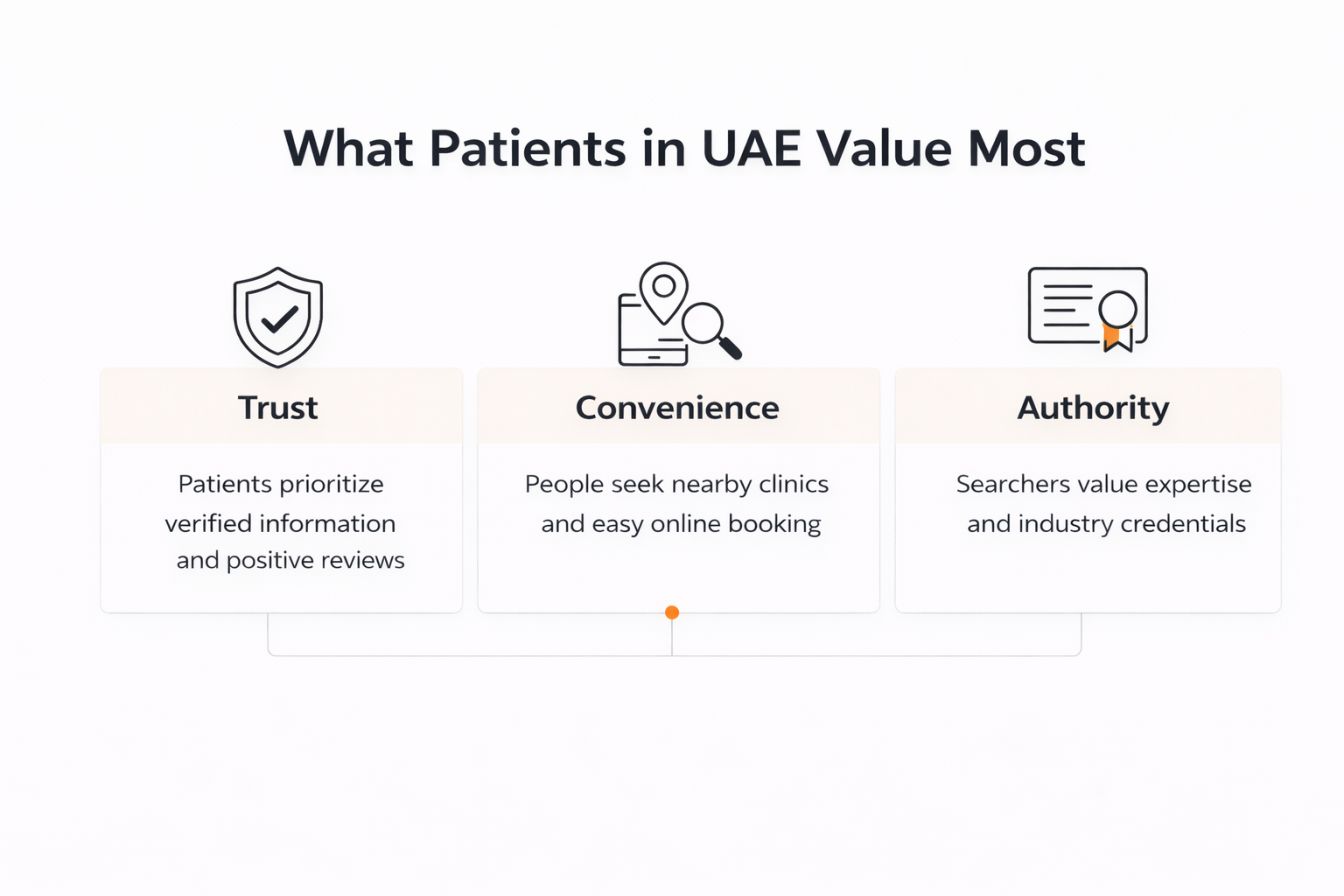
The answer is very simple. Convenience and trust. In Dubai, a population with ample resources and very affluent people live. They don’t care for the fees that they need to spend, but they need proper medical guidance from experts who have spent their life dedicated to medical excellence.

Here’s how things take a turn.

A recent study on Healthcare done by Brand Finance, a UAE based research and consulting company, found these specific insights that turned everything very clear.

  • 81% of residents consider the UAE’s healthcare system to be high quality
  • 84% of UAE residents believe the country’s healthcare has improved over the past decade
  • SEHA is the most highly regarded healthcare provider in the UAE

In fact, their Managing Director, Mr. Richard Haigh, quoted:

The average annual healthcare spend of UAE is AED7, 600 (USD2,100) per person.

It depicts that patients demand expertise and trust more than affordability.

Thus, its impact is real. But how do you exactly leverage it? The answer is Simple Healthcare SEO.

What to look out for Healthcare SEO in UAE?

Simple, just follow these simple criterion:

  1. Trust and Authority is loved more.
  2. A Mobile Friendly Website is mandatory
  3. Aim for Awareness not promotion.
  4. Be Visible and credible for everybody.

This simple criterion pretty much combines the overall idea of Clinic SEO in UAE and attracts patients.

Now, let’s move on to the most awaited discussion.

TOP Healthcare SEO Strategies for 2026

1. A clean, user friendly website

A website is the front door of your clinic online. If it is slow, confusing, or insecure, people leave and never come back. Make the site simple and useful.

Mobile friendly

Most people search from phones. Your website must look good and work fast on small screens. Use large buttons, clear fonts, and a layout that fits a phone screen. Test booking and contact forms on a phone and fix any problems. If the site feels slow or the buttons are hard to tap, patients will call competitors instead.

SSL certificates

Always use HTTPS. That little lock icon in the browser means the site is secure. Patients enter personal details and sometimes payment data. A secure site protects them and builds trust. Search engines also prefer secure websites, so SSL helps with ranking too.

Simple URLs

Keep web addresses easy to read and descriptive. For example, use /dental-implants-dubai rather than /page?id=123. Simple URLs help users remember pages and help search engines understand what each page is about. Use short words, include the main keyword for the page, and keep folder structure logical.

Extra practical tips

Make contact details visible on every page. Put phone number, location, and opening hours at the top. Use fast hosting and compress images so pages load quickly. A clean website means fewer clicks to book an appointment and more patients walking in.

2. Google Business Profile

Your Google Business Profile is the most visible listing for local searches. When someone searches for “clinic near me” your GBP is what appears on the right side of Google or at the top of mobile results. Treat it like a mini-website that must stay fresh.

Optimize it regularly

Keep the profile updated with clinic hours, holiday schedules, and service lists. Add high quality photos of your clinic, waiting area, staff, and equipment. Post short updates weekly: new services, health tips, or appointment availability. These posts help your profile stay active and signal to Google that you are a real, local business.

Ask for Google reviews

Patient reviews are powerful. They increase trust and help your profile rank higher. Ask satisfied patients to leave a short review and give them clear instructions, for example: “Please tap this link and write a sentence about your visit.” Respond to every review, positive or negative, with a polite, helpful reply. When you show care in responses, new patients notice.

Provide direct links

Make it easy for users to act. Put clickable links for booking, teleconsultation, directions, and the clinic phone number in your business profile. Use a clear booking page so patients can reserve a time in one or two taps. A profile with easy calls to action converts searches into appointments.

3. Informational and awareness based content

People search for answers, not ads. When your clinic gives clear, helpful medical information, you win trust and traffic. This is where content becomes your best long-term asset.

Bust myths

Pick the common myths your patients believe and write simple, fact based pages that correct them. For example, “Does everyone need a CT scan for headaches?” Explain the correct approach in plain language, use short bullet lists of warning signs, and end with a suggestion to book a specialist review if needed. Myth busting builds authority and reduces fear.

Spread awareness

Use blog posts, short videos, and infographics to teach basic health steps: when to see a doctor, how to prevent seasonal illness, or what to expect from a common treatment. Share these on social media and your Google Business Profile. Awareness content positions your clinic as helpful and human, not just a place that takes money.

Include long-tail keywords for niche traffic

Long-tail keywords are the phrases patients actually type, like “best paediatrician in Abu Dhabi who treats eczema” or “how to stop nosebleeds at home in Dubai.” Create pages that answer these precise queries. These pages do not need huge traffic to be valuable. A few patients from each long-tail search add up to steady bookings.

Practical content rules

Use clear headlines, short paragraphs, and patient friendly language. Add trusted references where relevant, and include the clinician’s name and short bio to boost credibility. Each page should end with a clear next step: call, book, or request a tele consult.

Conclusion and next step

These three strategies a clean website, an optimized Google Business Profile, and helpful informational content form the backbone of modern healthcare SEO for 2026. They are low cost, high impact steps you can start today, and they work especially well in the UAE where patients value trust and clarity.

If you want a complete, step-by-step SEO plan tailored to your clinic, Tikz Media has a full guide and hands-on services to help you implement every item above. Visit Tikz Media for complete SEO Services guidelines, a free clinic audit, and a demo of how these changes will improve your visibility and patient bookings. Take that next step and make your clinic easy to find and hard to ignore.

If you have more doubts, you can refer these FAQs.

hii

SEO in 2026: Why It Still Matters and How AI Citations Work

From the day Open AI launched ChatGPT, there was a sudden shift that businesses didn’t notice. Now, the same shift is the reason why we think SEO is outdated. And so are the companies that provide SEO services.

Today, over 400 Million people use Chat GPT every week and trust it for its reliability. The emergence of AI is visible and clear. But what it means for businesses who want to establish digital presence? And what does it mean for SEO agencies?

At Tikz media, we have turned AI into our biggest Leverage. In fact, we believe SEO is still prevalent and one of the most important things which helps you establish your presence in the digital world, but in a little different way. In this blog, let’s understand what most people missed about AI, does SEO still matter, and what strategies one can use to increase its presence in this changing digital world.

What is SEO in 2026? Does it Matter?

Let’s start with the Basics. Search Engine Optimization, popularly known as SEO, is the process of improving a website’s visibility and ranking on Search Engine like Google & Brave to attract people by making content which is relevant to both users and the search engine.

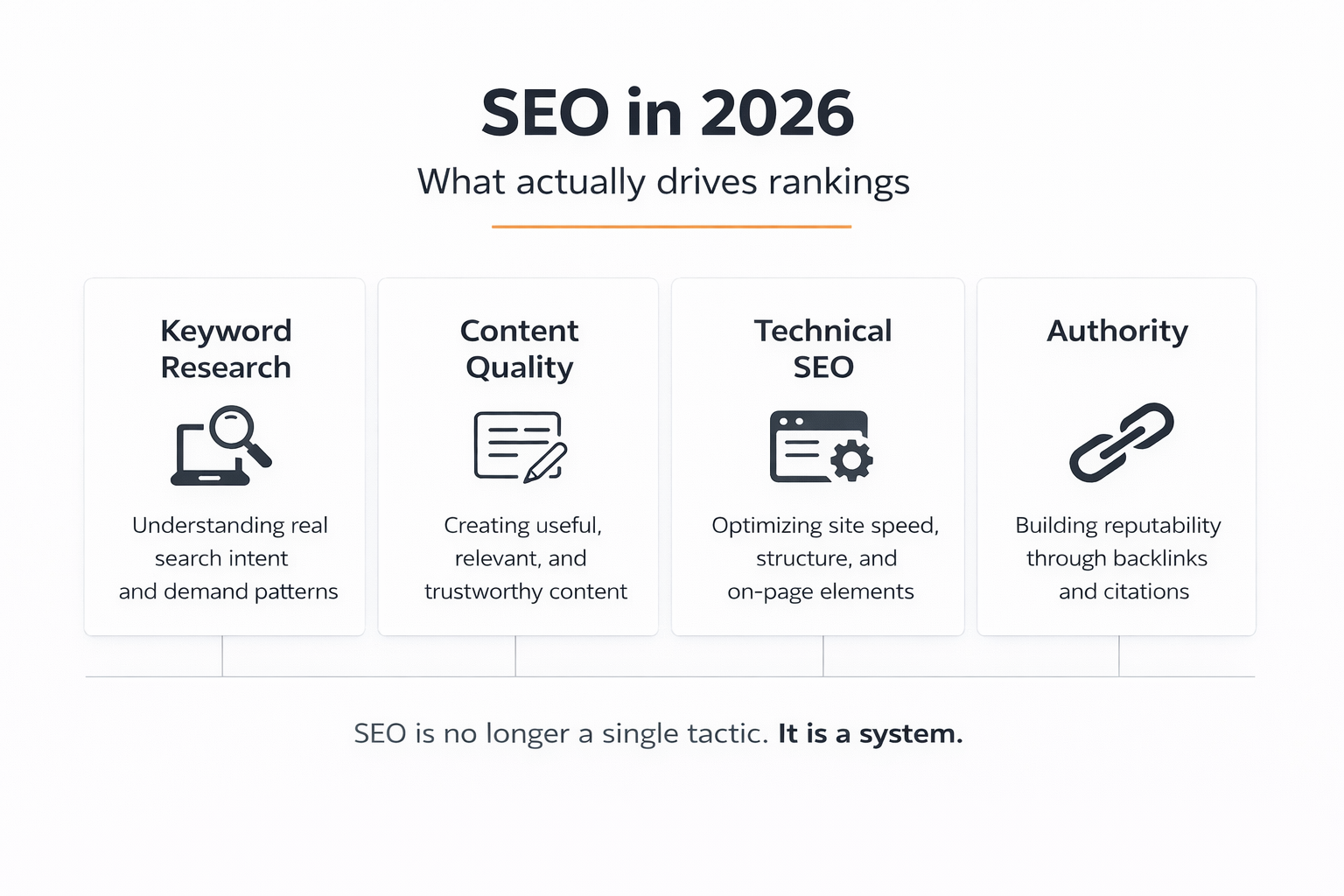
The Core components of SEO include:

  1. Keyword Research: Identifying the words and queries that your target audience search to get the answers.
  2. High Quality Content: Optimizing the web pages with content (titles, images, text, meta descriptions) with specific keywords that you target.
  3. Technical SEO: Optimizing the user experience in a way that people can access your website with ease, i.e. mobile-friendly design, fast loading speed, and structure which is easy to categorize and index
  4. Authority: Building authority & trust by backlinking the other reputable websites and brand mentions.

An SEO Agency helps you achieve that with ease. However, this is old. Now, as 2026 is approaching, and AI has emerged, it’s important that we use AI to leverage and increase brand influence. SEO services in 2026, majorly rely on the LLM citations.

And this has changed SEO services on a major level. The dependence on SEO is still broad and strong, but the way people see your brand is changing. Let’s understand what has changed.

Changing Search Behaviours in 2026

As mentioned above, AI has replaced the Google search broadly.

Nowadays, people go directly to chatbots like Perplexity Chat GPT, Grok, Claude, etc. to clear everything in one go. This is popularly known as a Zero-Click Search. The users do not click on any website link, they just open a Chatbot and the Chatbot searches it, gathers relevant information, and gives out summaries that are impactful.

Here’s what fuels this change:

1. Convenience

People love convenience. They’d do anything to get a little more comfort. Chatbots are that convenience. All the information clear and visible, just by typing a simple query.

Result: No one wants to open websites and browse for information like they used to.

Business Impact: Brands do not find relevancy via traditional SEO Services

2. Trust

The Chatbots are built and trained on High Quality content, mostly which appears on google search. This lets them scrounge and give a favourable result faster than traditional research.

Result: users now trust AI more than traditional Google search

Business Impact: Brands who provide credible information get cited in chatbots which increases traffic on the website.

This way trust and convenience has shifted towards AI Chatbots and have rewired user persona.

So, what can we do?

The answer is pretty simple. We can leverage AI. But for that we’ll have to understand how AI modules are built, what information do they show in their answers and summaries.

How to leverage AI? Top On Page SEO strategies for 2026!

A recent study on 177 million sources that got mentioned in AI search results showed a very specific trend in content that receive citations.

Type of Content Share (%) Citations
Comparison List Articles 32.5 57,591,022
Blogs 9.91 17,565,744
Commercial 4.73 8,376,007
Homepage 3.75 6,637,322
Forum/Community 3.36 5,950,684
Wiki/Documentation 2.73 4,835,532
News 2.1 3,723,397
Video Content 0.95 1,680,158
Search Pages 0.62 1,100,989

Key Takeaway: Build Comparision List Articles (queries like “Best”, “Top”, “Compare”, “Vs”, “Alternatives”) as the foundation for AI search assets.

Other major findings in the same study mentioned a few tips which you can use for developing more on-page presence that gets clearly indexed in AI.

The findings are as follows:

  • FAQs which people ask as follow up questions are likely to be indexed.
  • Align content with different platforms. Perplexity uses more semantic content, while Chat GPT indexes more wiki/documented content.
  • Position Zero (Google AI Overviews) is highly influenced by Google Ranking. If you list on top 10 there’s a 33.7% chance to get cited in Position Zero.
  • Reviews and community based content is likely to be cited by AI in decision making questions.
  •  All 177 Million Searches which were cited had used Tables, pointers, and structured sentences which were easy for models to understand.

Leveraging AI through Off-Page SEO & Technical SEO Strategies

World of AI searches is not very different than SEO. What we have observed is quite different than what people say about AI searches.

As an SEO Agency, Tikz Media monitors different domains and brands to cut through the noise and increase the presence for clients. And during crucial steps we find several revolutionary tricks which help in increasing AI search citations.

Here’s what exactly we have observed in Off-Page SEO:

1. Expert Bylines and Bios:

Clear author attribution and professional bios help establish trust and authority. Adding an expert byline shows that the content is written by a real, knowledgeable person. A short bio that highlights the author’s role, experience, or credentials further strengthens credibility.

2. Prefer llms.txt, over robots.txt

The llms.txt file is quickly emerging as a standard for controlling how AI systems interact with website content. It allows site owners to guide what parts of their content AI models are allowed to access, read, or ignore. Similar to how robots.txt works for search engines, llms.txt gives more control over data usage.

3. Backlink on Websites that appear in Citations

Backlinks from websites that are frequently referenced or cited add strong credibility to your content. When your site is linked from trusted sources that already appear in citations, it signals reliability and authority. This helps search engines and AI systems view your website as a dependable source, improving visibility and strengthening overall trust.

4. Structured Data

Create content that clearly explains key processes like signing up, qualifying, integrating, or completing actions, using simple step by step flows that can be easily followed or mirrored. Align each explanation with the exact action you want to drive, such as bookings, purchases, or configuration. Support this with structured technical workflows, including APIs for pricing, availability, and transactions, along with webhooks and callbacks for confirmation. The content should directly answer whether the process can be automated, what requirements are needed, and how success is defined.

Why Businesses Still Need SEO?

So, does SEO still matter in 2026?

While we talk about AEO and LLM citations, studies shows that it’s heavily influenced by SEO, just as how a playback singer rather than a live performance.

AI rankings and Google search Rankings both are equally important. Says, Samanyou Garg, the CEO of WhiteSonic.

The answer is yes, but for reasons many businesses overlook.

First, SEO builds discoverability. Whether it is Google, AI overviews, or chat based search, strong SEO ensures your content is visible where people ask questions.

Second, SEO builds trust. AI systems and users both rely on structured, credible, and well optimized content to decide what information is reliable.

Third, SEO builds long term leverage. Paid ads stop the moment you stop paying, but SEO compounds over time, turning your website into a lasting digital asset.

SEO is no longer just about rankings. It is about being understood, cited, and trusted by both humans and machines. Businesses that adapt to this shift will not disappear in the AI era. They will lead it.

Final Perspective

To conclude, SEO Services in 2026 is not optional, it is foundational. Visibility, trust, and long term growth now depend on how well your content is structured, understood, and trusted by both search engines and AI systems. Businesses that take SEO seriously today are the ones that will dominate attention tomorrow. This is where the right strategy and execution matter.

Tikz Media as an SEO Agency helps brands build future ready SEO that goes beyond rankings and focuses on authority, clarity, and conversions. If you want your business to be discovered, trusted, and chosen in the next phase of digital search, now is the time to work with Tikz Media and turn SEO into your strongest growth channel.